There is a particular kind of anxiety that comes with shipping freight for the first time. You hand over a pallet of goods, get a piece of paper with a tracking number, and then... you wait. Hours pass. Maybe a full day. You refresh a webpage, type in a number, and stare at a status update that reads "In Transit" without telling you anything useful.
If you have ever shipped freight using LTL freight services and felt completely lost during the process, you are not alone. Understanding less than truckload tracking is one of those things nobody really explains clearly to new shippers. It sounds technical. It feels complicated. But once you understand how the system actually works, it becomes a lot less mysterious and a whole lot easier to manage.
This guide is written specifically for people who are just getting started. No jargon walls. No assumptions. Just a clear, honest walkthrough of how LTL shipment tracking works, what the numbers mean, and how to stay informed without losing your mind.
What Does LTL Actually Mean and Why Does It Matter for Tracking?
LTL stands for Less Than Truckload. It simply means your shipment does not fill an entire truck. Instead of paying for a full trailer, you share space with other shippers who are also sending goods in the same general direction. You only pay for the space your freight occupies, which makes it a very cost-effective option for small to mid-sized businesses.
Now here is where tracking becomes a little different compared to parcel shipping. When you send a box through a courier, it moves from one sorting facility to the next in a fairly predictable, linear path. With LTL freight, your pallet may stop at multiple terminals, get transferred between trucks, consolidate with other loads, and still arrive right on schedule. This multi-stop nature is why tracking LTL shipments requires a slightly different mindset.
Understanding this upfront will save you a lot of unnecessary worry later when your tracking update shows your freight sitting at a terminal for a day or two. That is usually completely normal.
The PRO Number: Your Most Important Piece of Paper
When your LTL carrier picks up your shipment, they assign it a PRO number. This is a unique identifier, typically nine digits, that the carrier uses to track your freight throughout its entire journey. Think of it as your shipment's fingerprint.
You will find the PRO number printed on your Bill of Lading (BOL) and sometimes on a barcode sticker that gets attached directly to your pallet. Keep this number somewhere safe the moment you receive it. It is the single most reliable way to check your shipment status with almost any LTL carrier.
Besides the PRO number, you may also encounter these reference numbers during the shipping process:
Bill of Lading (BOL) Number: This is the primary shipping document. It outlines what is being shipped, where it is going, and who is responsible for it.
Purchase Order (PO) Number: This is your internal reference number assigned at the time of purchase. Many carriers allow tracking via PO number as well.
Pickup Number: This is generated when the carrier confirms your freight has been picked up from the origin location.
How Less Than Truckload Tracking Actually Works Step by Step
Once your freight leaves your facility, it enters a network of operations that can feel invisible from the outside. Here is what is actually happening behind the scenes at each stage.
Stage 1: Pickup and Origin Scan
A driver comes to your location, loads your freight, and scans it into the carrier's system. This is when your PRO number becomes active. You should see a status update like "Shipment Picked Up" or "Origin Scan Complete" within a few hours of the pickup.
Stage 2: Origin Terminal Processing
Your freight is taken to the carrier's local terminal, where it is sorted, consolidated with other LTL shipments heading in the same direction, and loaded onto a linehaul truck. This can take anywhere from a few hours to overnight. Patience here is key.
Stage 3: Linehaul Transit
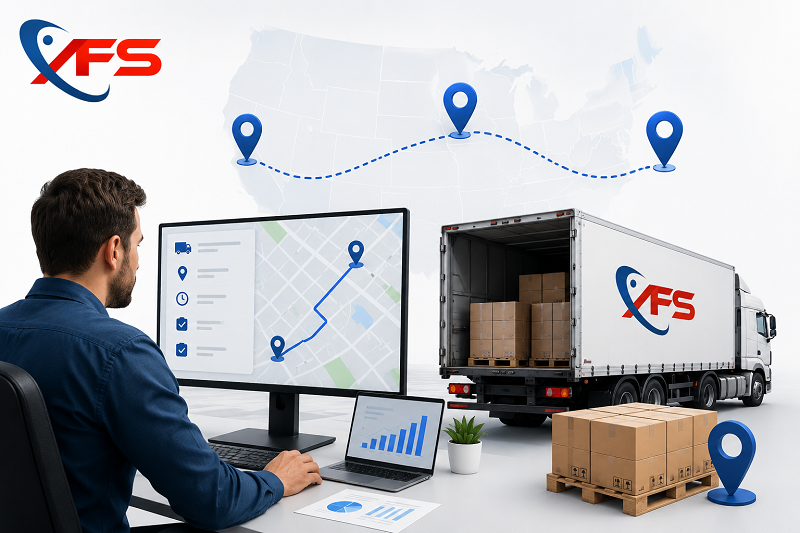
This is the long-distance portion of the journey. Your freight moves from the origin terminal toward the destination region, sometimes passing through intermediate break-bulk terminals for re-sorting. Each terminal scan creates a new tracking event in the carrier system.
Stage 4: Destination Terminal and Final Delivery
Once your freight arrives at the destination terminal near the receiver, it gets sorted again and loaded onto a local delivery truck. A delivery appointment may be scheduled depending on the service type. When the driver arrives and the receiver signs for the freight, your tracking will show "Delivered" along with the name of the person who accepted it.
Reading Your Tracking Status Updates Without Confusion
One of the most frustrating things for new shippers is staring at a status update and not knowing what it actually means. Here is a plain-language breakdown of the most common tracking statuses you will encounter.
"In Transit" simply means your freight is moving through the carrier network. It does not mean it is on a truck at that exact moment. It could be sitting at a terminal waiting to be loaded.
"Out for Delivery" means a local delivery driver has your freight on their truck and is making deliveries in your area. This is the closest you will get to a real-time location update.
"Exception" is the word nobody wants to see. It means something unexpected happened, such as a missed delivery attempt, incorrect address, weather delay, or damaged freight. Contact your carrier immediately when you see this status.
"On Hand" typically means your freight arrived at a terminal but has not yet been loaded onto the next truck. This is normal and usually resolves within 24 hours.
Common Tracking Challenges New Shippers Face and How to Handle Them
Even experienced logistics teams run into issues. Knowing what to expect and how to respond makes all the difference.
Tracking Not Updating for 24 to 48 Hours
This happens more often than you would think, and it does not always mean something is wrong. Carriers update their systems at varying intervals, and some regional terminals are slower to input data. If your tracking has not moved in more than 48 hours during what should be a transit period, it is reasonable to call the carrier's customer service line and ask for a manual trace.
Estimated Delivery Date Changed Without Warning
LTL transit times are estimates, not guarantees (unless you purchased a guaranteed service). Weather, dock congestion, driver availability, and route changes can all push delivery dates back. Setting realistic expectations with your receivers upfront will prevent most of the friction that comes from delivery delays.
Multiple Tracking Numbers for One Shipment
If your shipment was split across multiple pallets or re-manifested at a terminal, you might end up with more than one PRO number. This is actually more common than people realize with larger LTL loads. Ask your carrier to link them or track each one separately.
How to Choose a Reliable LTL Carrier or Freight Partner
Not all LTL carriers offer the same level of visibility into your shipment. Some have invested heavily in technology and provide real-time GPS-level updates. Others still rely on manual terminal scans that can be hours or even a day behind. Before committing to a carrier or freight broker, it is worth asking a few direct questions.
Ask whether they offer automated shipment notifications via email or text. Ask whether their tracking portal is available 24/7 without requiring a login. Ask what their process is when a shipment exception occurs. A freight partner like AFS Trans Co. that prioritizes proactive communication and transparent tracking can make a huge difference in your day-to-day shipping experience, especially when you are just starting out and have not yet built a feel for the process.
Visibility is not just a nice-to-have anymore. It is a basic expectation in modern freight shipping, and any partner worth working with will understand that.
Practical Tips to Stay on Top of Your Shipments Every Time
Here are some habits that experienced LTL shippers develop over time. Building these into your routine early will save you a lot of headache down the road.
Always save your PRO number immediately after pickup confirmation. Screenshot it, write it down, or copy it into your shipment log. Do not wait for a formal document to arrive.
Set up email or SMS tracking alerts if your carrier offers them. Being notified automatically is far better than manually checking a portal three times a day.
Notify your receiver of the expected delivery window before freight arrives. A receiver who is not ready to accept a delivery can create serious delays, missed delivery fees, and even storage charges if the carrier has to hold your freight at the terminal.
Keep your BOL and shipping documents organized and accessible. If there is a dispute, a claim, or a billing question, these documents are the first thing any carrier will ask for.
Check the Proof of Delivery (POD) once your freight is marked as delivered. The POD tells you exactly when the freight arrived, who signed for it, and sometimes includes notes about the condition of the shipment at delivery.
Why Getting Tracking Right from the Start Sets You Up for Long-Term Success
There is something that experienced logistics professionals understand which newer shippers often discover the hard way: visibility in your supply chain is not just about convenience. It directly affects your customer relationships, your operational planning, and your bottom line.
When you know where your freight is at any given moment, you can communicate confidently with your customers. You can adjust your production schedule if a critical shipment is running late. You can flag a potential problem before it becomes a costly one. The businesses that master less than truckload tracking early in their shipping journey tend to build stronger vendor and customer relationships over time simply because they are more reliable and responsive.
Think about it from your customer's perspective. When they ask where their order is, you want to have a real answer, not a vague "it's on its way." That kind of confidence only comes from having solid tracking practices in place.
Working with a dedicated freight partner like AFS Trans Co. can dramatically simplify this process. Rather than managing relationships with multiple carriers and juggling different tracking portals, a good freight partner acts as a single point of contact for all your LTL shipping needs, giving you consolidated visibility and someone to call when things go sideways.
Final Thoughts: Tracking Is a Skill Worth Learning Early
Nobody becomes an expert in freight shipping overnight. There is a learning curve, and some of that learning happens through real experience, through delayed shipments, confusing status updates, and the occasional scramble to locate a pallet that seems to have disappeared into a regional terminal somewhere in the middle of the country.
But the fundamentals of less than truckload tracking are genuinely learnable, and once you understand them, the whole process feels much more manageable. Know your PRO number. Understand the stages freight moves through. Read your status updates without panic. Build a relationship with a carrier or freight partner who values communication.
Your freight is out there moving through a complex, well-coordinated network of trucks, terminals, and drivers right now. And with the right knowledge and the right tools, you can stay connected to every step of that journey.