Returns are not going away. In fact, they are getting bigger, louder, and more expensive every single year. In 2024 alone, U.S. retailers saw over $890 billion worth of products returned, and that number is already climbing higher in 2025. If you are running a business that ships products, there is a very good chance returns are quietly eating into your margins in ways you have not fully measured yet.
But here is what most business owners get wrong: they treat returns as a problem to survive, not a process to optimize. That single mindset shift is where everything changes.
At AFS Trans Co., we have seen firsthand how businesses transform their bottom line simply by taking their return operations seriously. And the backbone of that transformation is a well-built, professionally managed returns process that works for both the business and the customer.
What Reverse Logistics Services Actually Do for Your Business
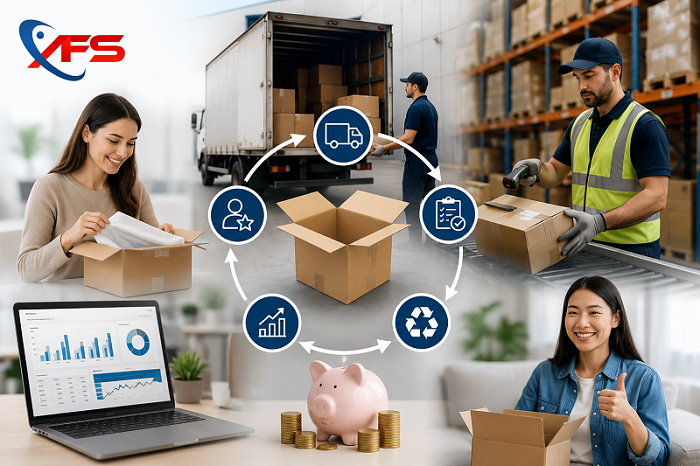
Before we get into the numbers, it helps to understand what we are really talking about. When a customer sends something back, that product needs to travel, get inspected, get sorted, and then either go back to a shelf, get refurbished, get recycled, or get disposed of. Every one of those steps costs time and money if managed poorly.
Reverse Logistics Services cover all of that. They are the operational systems, people, and technology that manage the backward flow of goods through your supply chain. Think of it as the return lane on a highway: without it, everything backs up and causes chaos.
Here is where it gets interesting. Businesses that invest in professional Reverse Logistics Services do not just save money on handling costs. They unlock value that would otherwise be permanently lost.
How Returns Management Directly Cuts Your Costs
Let us talk money, because that is what drives decisions.
Reduced Labor and Processing Costs
When returns are handled without a clear system, your warehouse team ends up improvising. Products pile up. Workers spend hours figuring out what to do with each item. Time gets wasted, errors happen, and labor costs spike.
Automation and structured workflows change that completely. Modern returns processing technology can handle thousands of units per hour. Studies from logistics research firms show that automated returns systems cut labor costs by roughly 30% and speed up the overall process by 50 to 60%. Those are not small numbers for a business processing hundreds of returns weekly.
Recovered Product Value
Here is something that surprises a lot of business owners: a significant portion of returned products can be resold, refurbished, or repurposed. Without a proper recovery system in place, those products often end up in a landfill or written off entirely.
With a structured recovery process, businesses can recapture up to 65% of a returned item's original value. That is recovered revenue that previously just disappeared. For a company processing $500,000 in annual returns, that could mean recovering $300,000 or more that was previously treated as a total loss.
Lower Storage and Inventory Holding Costs
Returned inventory that sits unprocessed in a warehouse takes up space and ties up capital. The longer it sits, the more it costs and the more its resale value drops. A fast, efficient returns pipeline means products get cleared quickly, shelves stay organized, and your storage costs stay under control.
Smarter Transportation Spending
Transportation is one of the biggest cost drivers in any return operation. Shipping individual items back one by one is expensive. Consolidating returns through a centralized processing hub, using optimized routing, and batching shipments together dramatically reduces per-unit transportation costs. This is one of the core things that professional Reverse Logistics Services do exceptionally well.
The Customer Satisfaction Side of the Equation
Cost savings alone would be enough reason to care about this. But there is another dimension that matters just as much, and arguably more over the long term: what your returns experience does to your relationship with customers.
The data here is pretty striking.
Research shows that 95% of customers will avoid buying from a brand again after a bad return experience. Read that again. One frustrating return can permanently lose you a customer. On the flip side, 67% of shoppers check a retailer's return policy before they even make a purchase. Your returns process is not just an operational concern. It is a sales tool.
Speed Builds Trust
When a customer sends something back and hears nothing for two weeks, their anxiety grows. They start wondering if the return was received. They wonder when they will get their refund or replacement. That uncertainty is uncomfortable, and it damages how they feel about your brand.
A well-managed return system sends confirmation emails, provides tracking, and processes refunds quickly. That speed and transparency communicates to the customer that they matter. It turns a potentially negative experience into a neutral or even positive one.
Hassle-Free Returns Drive Repeat Business
Think about the last time you had to jump through hoops to return something. Print a label, find a box, drive to a drop-off location, wait on hold with customer service. Compare that to a smooth, one-click return process with a pre-paid label. The difference in how those two experiences feel is enormous.
Businesses that partner with AFS Trans Co. for their returns management consistently report higher customer retention rates. That is not a coincidence. When returning something is easy, customers trust the brand more, not less. They know that if something goes wrong, they are protected. That security is what builds loyalty.
Faster Exchanges Mean Fewer Lost Sales
Sometimes a customer does not want a refund at all. They want the right size, the right color, or a replacement for a damaged item. Every day that exchange takes to process is a day that customer is without the product they wanted. If that window stretches too long, they buy from a competitor instead.
A streamlined reverse flow gets that replacement out the door faster. The customer gets what they need sooner, and you keep the sale.
The Sustainability Factor (Which Also Saves Money)
This might seem like a bonus point, but it is increasingly becoming a business necessity. Consumers care more about where their returned products end up than ever before. About 25% of returns currently end up in landfills, which is both an environmental problem and a waste of recoverable value.
Circular economy practices, including refurbishment programs, resale channels, and responsible recycling, reduce waste while generating additional revenue streams. Many businesses are discovering that their sustainability efforts and their cost-saving efforts are pointing in exactly the same direction. Well-designed Reverse Logistics Services help you build those circular processes in a way that is both ethical and financially smart.
Why Outsourcing Makes More Sense Than Going It Alone
Some businesses try to build their return operations in-house. For very large enterprises with dedicated supply chain teams, that can work. But for most growing businesses, it is an expensive, time-consuming path that distracts from core operations.
Third-party logistics providers who specialize in returns management bring something valuable: experience at scale. They have already solved the problems you are about to encounter. They have the technology, the warehouse infrastructure, the trained staff, and the carrier relationships to handle returns more efficiently than most businesses can build internally.
The global reverse logistics market is now valued at over $872 billion and is projected to reach $1.75 trillion by 2035. That growth reflects how seriously the industry is taking this space. The companies growing fastest within it are the ones who partnered with specialists early rather than trying to reinvent the wheel.
At AFS Trans Co., we work with businesses across industries to build return operations that are lean, fast, and customer-friendly. From warehouse processing to transportation coordination to final disposition decisions, our team handles the complexity so you can focus on growing your business.
Signs Your Current Returns Process Needs Attention
Not sure where you stand right now? Here are some honest signals that your reverse operations may be costing you more than they should.
Your warehouse regularly has piles of returned product waiting to be processed with no clear timeline. Your customer service team gets a high volume of calls or emails specifically about return status. Your refund turnaround time is longer than five to seven business days. You have limited visibility into why products are being returned. You are writing off most returned inventory as a loss without attempting recovery.
If any of those sound familiar, you are not alone. These are extremely common issues. The good news is they are also fixable with the right systems and the right partner.
A Smarter Way to Think About Returns
Here is a perspective worth sitting with. Every return that moves through your supply chain is a data point. It tells you something about product quality, about customer expectations, about how well your product descriptions match reality, about sizing guides, packaging durability, and more.
Businesses that mine that data intelligently use it to reduce future return rates, improve product quality, and fine-tune their marketing. The return process, when managed well, becomes a feedback loop that makes the entire business better over time.
That is a very different way of seeing returns. Not as a cost center to minimize, but as a source of insight to leverage.
Conclusion
Returns will always be part of doing business. The question is never whether you will have to deal with them. The question is whether your process makes them better or worse for both your finances and your customers.
The businesses winning in today's competitive market are not the ones with the lowest return rates. They are the ones who have built return experiences so smooth and so reliable that customers feel safe buying in the first place. They are recovering product value that used to disappear. They are using return data to improve every other part of their operation.
That is what a well-run return operation delivers. And it starts with taking it as seriously as every other part of your supply chain.
If you are ready to build a returns process that actually works, the team at AFS Trans Co. is here to help you get there.