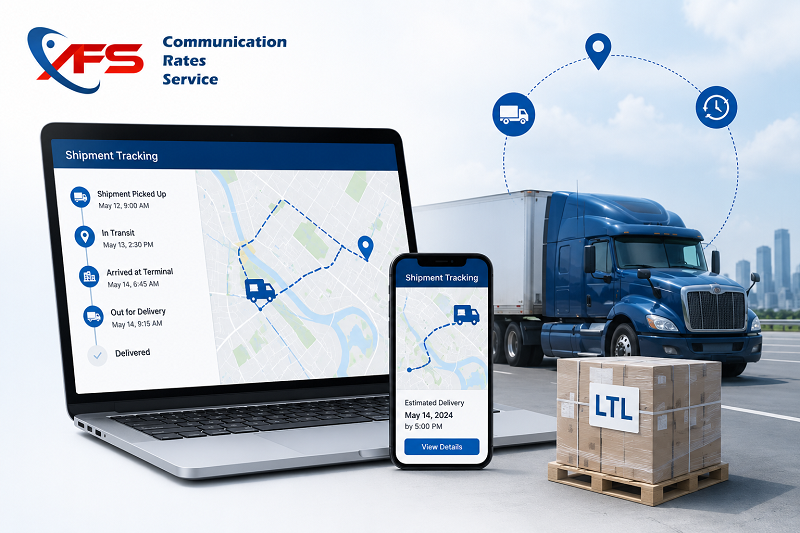
If you have ever refreshed a tracking page five times in ten minutes waiting for a status update, you already know the quiet frustration of freight shipping. You know the truck left the dock. You know it's somewhere between point A and point B. But "somewhere" isn't an answer your customer wants to hear, and it isn't one you want to give them either.
That gap between "shipped" and "delivered" is where most shipping headaches live. The good news is that gap has gotten a lot smaller in recent years, and understanding how to close it can save you time, money, and more than a few stressful phone calls.
Key Takeaways
Before we get into the details, here's the short version:
- Less than truckload tracking is the process of monitoring a partial freight shipment's location and status as it moves through a carrier's network, usually through GPS data, barcode scans, and electronic logging devices.
- Real time visibility reduces delivery surprises, improves customer communication, and helps catch delays before they become costly problems.
- Most carriers provide tracking through a PRO number, a unique identifier assigned to each shipment.
- Combining carrier portals, EDI integration, and third party tracking tools gives shippers the most complete picture.
- Proactive tracking habits, not just the tools themselves, are what actually prevent late deliveries from catching you off guard.
Now let's unpack each of these in plain language, with practical steps you can actually use.
What Is Less Than Truckload Tracking, Exactly?
Less than truckload tracking refers to the monitoring of a shipment that doesn't fill an entire trailer and instead shares space with other shippers' freight. Because LTL freight changes hands at multiple terminals on its way to its final stop, tracking it accurately requires more checkpoints than tracking a full truckload that travels directly from origin to destination.
In simple terms, every time your pallet gets scanned, weighed, loaded, or moved between trucks, that event gets logged. Less than truckload tracking pulls those logged events together so you can see where your shipment actually is, not just where it was supposed to be.
This matters because LTL freight, by its nature, makes more stops than full truckload freight. Each stop is an opportunity for a delay, a missed connection, or a damaged pallet. Visibility into those stops is what separates a smooth shipment from a stressful one.
Why This Type of Tracking Is Different From Truckload Tracking
A full truckload shipment usually has one pickup and one delivery. The tracking story is simple: it left, it's en route, it arrived.
LTL freight tells a more complicated story. A pallet might leave a shipper's dock in Chicago, get cross docked at a terminal in Indianapolis, switch trailers, and arrive in Columbus two days later. Each of those touchpoints needs its own scan and timestamp for accurate tracking.
| Factor | Truckload (FTL) | Less Than Truckload (LTL) |
|---|---|---|
| Number of stops | Usually 1 to 2 | Often 3 or more |
| Tracking complexity | Low | Moderate to high |
| Typical visibility tool | GPS only | GPS plus barcode scans plus EDI |
| Risk of delay points | Fewer | More, due to terminal handling |
| Common tracking ID | BOL number | PRO number |
Understanding this difference is the first step toward setting realistic expectations for delivery windows and knowing what "on time" actually looks like for partial freight.
How Real Time Tracking Actually Works Behind the Scenes
Here's the part most guides skip over: tracking isn't magic, and it isn't a single piece of software. It's a chain of small data points stitched together.
- Pickup scan. When the carrier picks up your freight, the PRO number gets scanned and logged into the carrier's system.
- Terminal scans. Every time the shipment passes through a terminal, it gets scanned again. This is usually where shipments either move smoothly or sit waiting for the next outbound truck.
- GPS data from the truck. Most modern carriers equip trailers with GPS units, giving a rough real time location even between scans.
- Electronic logging devices (ELDs). These track driver hours and location, which indirectly helps estimate arrival windows.
- Delivery scan and signature. The final scan confirms delivery and closes the loop.
Each of these data points feeds into the tracking portal you check, whether that's the carrier's own website, a broker's dashboard, or a third party visibility platform.
Quick Answer: Can You Track LTL Freight in Real Time?
Yes, but with a caveat. Most carriers update tracking status at each scan point rather than continuously like a rideshare app. So while you won't usually see a live moving dot on a map, you will see frequent, meaningful updates as your shipment moves through the network. This is sometimes called "near real time" tracking, and for practical shipping purposes, it does the job.
The Tools That Make Less Than Truckload Tracking Possible
There isn't one single tool that does everything well. Most experienced shippers use a combination.
Carrier websites and apps Almost every major LTL carrier has a tracking portal where you enter your PRO number and get a status update. These are reliable but limited to that one carrier's data.
EDI 214 integration For businesses shipping frequently, EDI (Electronic Data Interchange) connects a carrier's tracking system directly to your own order management software. This means status updates appear automatically without anyone logging into a separate portal.
Third party visibility platforms These tools aggregate tracking data from multiple carriers into one dashboard. If you ship with several carriers, this saves a lot of tab switching.
Freight broker dashboards If you work with a broker or 3PL, they often provide a single point of contact and a consolidated tracking view across all your shipments, regardless of which carrier is handling each one.
At AFS Trans Co., shippers get exactly this kind of consolidated approach. Instead of juggling five carrier logins, freight visibility is centralized so customers can check status, get proactive delay alerts, and reach a real person if something looks off, all without digging through multiple systems.
Common Tracking Problems and How to Solve Them
Even with good tools, things go sideways. Here are the issues shippers run into most often, and what actually helps.
| Problem | Likely Cause | What To Do |
|---|---|---|
| Status hasn't updated in 24+ hours | Shipment sitting at a terminal | Call carrier directly with PRO number |
| Tracking shows "delivered" but customer says no | Wrong delivery address or POD mismatch | Request proof of delivery (POD) document |
| Tracking number not recognized | Shipment not yet scanned at pickup | Wait a few hours, confirm pickup with carrier |
| Conflicting updates across platforms | Data lag between systems | Treat carrier's own portal as the source of truth |
| Delay with no explanation | Weather, mechanical issue, or capacity problem | Ask for an updated delivery appointment window |
A small but important note: tracking systems are only as good as the data fed into them. A missed scan at one terminal can make a shipment look "stuck" when it's actually moving fine. This is why pairing automated tracking with a quick phone call, when something looks off, is still good practice even in 2026.
Best Practices for Staying Ahead of Delays
Good tracking habits matter just as much as good tracking software. Here's what experienced shippers tend to do differently:
- Save the PRO number immediately after booking, not after pickup
- Check tracking status once daily rather than constantly refreshing
- Set up automated email or text alerts if your carrier or platform offers them
- Confirm delivery appointment requirements in advance for time sensitive freight
- Keep a habit of comparing estimated transit time against actual scan history, so you start to notice patterns with specific lanes or carriers
Shippers who build these habits into their routine tend to catch problems two to three days earlier than those who only check tracking when a customer calls asking where their order is.
Final Thoughts
Freight tracking isn't about staring at a screen waiting for a status to change. It's about knowing where to look, what the data actually means, and when a quiet status update is normal versus when it's time to make a phone call.
Less than truckload tracking has come a long way from the days of calling a dispatcher and hoping for an honest answer. Between PRO numbers, terminal scans, GPS data, and consolidated dashboards, shippers today have more visibility than ever before. The shippers who get the most out of that visibility are the ones who treat it as a tool to act on, not just a number to check.
If your business ships LTL freight regularly, working with a partner who prioritizes clear, consolidated tracking can make a real difference in how smoothly your operations run. That's the kind of support AFS Trans Co. focuses on every day, so you spend less time chasing updates and more time running your business.
Frequently Asked Questions
Everything you need to know about less than truckload tracking.