You booked an LTL shipment. The truck pulled away from your dock. And now? You are sitting at your desk wondering exactly where your freight is, whether it is sitting at a terminal somewhere, whether it will arrive on time, and how you are supposed to answer your customer when they ask. That feeling is far more common than most people admit in the freight industry. And it is the exact reason less than truckload tracking exists. Not just as a feature, but as a necessity for anyone serious about running a smooth supply chain.
At AFS Trans Co., we have spent years helping businesses navigate the complexity of LTL shipping. One question we hear more than almost any other is simple: "How does LTL tracking actually work?" Not the marketing version. The real version, from pickup to proof of delivery.
This guide is the honest, practical answer to that question. We will walk through every stage of the process, explain the terminology that confuses people, and give you clear expectations of what visibility you can and cannot have during a shipment's journey.
What Makes LTL Tracking Different from Parcel Tracking?
Most people's reference point for shipment tracking is a UPS or FedEx package. You enter a number, you see a real-time dot on a map, and you get minute-by-minute updates. That experience is clean, fast, and intuitive.
LTL shipping is a fundamentally different animal. When you ship less than a truckload, your freight shares trailer space with shipments from multiple other businesses. That trailer makes stops at multiple terminals. Freight gets unloaded, sorted, consolidated again, and reloaded onto different trucks. Each hand-off introduces a new variable, a new scan point, and sometimes a new carrier system entirely.
This does not mean less than truckload tracking is unreliable. It simply means it operates differently, with its own identifiers, scan events, and status logic. Once you understand the system, it becomes much easier to interpret what you are seeing and what to do when something seems off.
Understanding the PRO Number
Every LTL shipment is assigned a PRO number (Progressive Rotating Order number) at the time of pickup. This is the primary identifier you will use to track your freight throughout its journey. Think of it as the shipment's unique fingerprint. Without it, tracking becomes significantly harder. Always confirm your PRO number with the carrier at the time of pickup and store it somewhere accessible.
The Step-by-Step Less Than Truckload Tracking Process
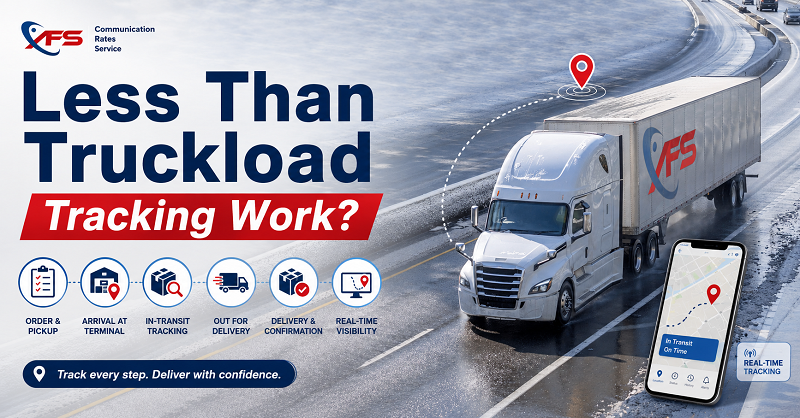
Here is what actually happens from the moment a driver leaves your facility to the moment your customer signs for the delivery. Each stage has its own scan events and status updates that feed into the carrier's tracking system.
Freight Pickup and PRO Number Assignment
The driver arrives, loads your freight, and generates a Bill of Lading (BOL). At this point, the carrier assigns a PRO number to the shipment. The first tracking scan happens here, confirming the shipment is in the carrier's possession. This is your starting point. Status: "Picked Up" or "In Possession of Carrier."
Arrival at the Origin Terminal
Your freight travels to the carrier's nearest local terminal, also called an origin service center. Here, it is unloaded from the pickup truck, scanned again, and staged for consolidation. This scan updates the tracking system and confirms the freight arrived at the first facility without incident. Status: "At Origin Terminal.
Linehaul Transit Between Terminals
This is the longest leg of the journey. Your freight is loaded onto a linehaul truck alongside other consolidated shipments heading in the same general direction. Depending on the distance, the freight may pass through one or several intermediate terminals. Each stop generates a new scan. Status updates may read "In Transit," "Departed Terminal," or “Arrived at Intermediate Hub.
Arrival at the Destination Terminal
Once the freight reaches the terminal closest to the final delivery address, it is unloaded, scanned, and sorted for local delivery. This scan is an important milestone because it typically triggers the carrier to schedule a delivery appointment or dispatch a local driver. Status: "At Destination Terminal" or "Out for Delivery."
Final Delivery and Proof of Delivery (POD)
The local driver delivers the freight to the consignee. Upon delivery, the recipient signs the delivery receipt. This signature is digitally captured and becomes the Proof of Delivery (POD) document. The final scan closes out the shipment in the tracking system. Status: "Delivered." You can typically download the POD directly from the carrier's tracking portal within hours of delivery.
Reading LTL Tracking Statuses: What They Actually Mean
Carrier tracking portals can sometimes feel like they were written in a language designed to confuse rather than inform. Here is a plain-language breakdown of the status messages you will most commonly encounter when monitoring less than truckload updates.
Common LTL Tracking Status Definitions
- Pickup Scheduled: The carrier has accepted the booking but has not yet collected the freight.
- In Transit: Freight is moving between terminals. No action needed unless a delivery window is approaching.
- Exception: Something unexpected has occurred, such as a missed delivery attempt, incorrect address, or damage noted. This requires your attention immediately.
- On Hand / Held at Terminal: Freight has arrived but delivery has not been completed. Often due to a missed appointment, holiday, or delivery area restriction.
- Delivered: The consignee has signed for the freight. Look for the POD document to confirm all items were received in good condition.
- Delivery Appointment Required: The carrier needs to schedule a time with the consignee before attempting delivery. Common for residential addresses or facilities with limited dock hours.
Why Gaps in LTL Tracking Happen (And What to Do About Them)
One thing that surprises many first-time LTL shippers is that tracking updates are not always continuous. You might see a scan at the origin terminal on Monday and then no update until Wednesday when the freight arrives at the destination terminal. This is normal, and here is why it happens.
Unlike parcel carriers, most LTL carriers do not scan freight at every single touch point. Some intermediate terminal transfers happen without a scan event being recorded in the customer-facing system. The freight is still moving; it is simply not visible in the portal at that moment. This is one of the key differences that makes less than truckload tracking feel less transparent compared to parcel shipping.
Pro Tip from AFS Trans Co.: If you have not seen a tracking update in more than 24 hours and the estimated delivery date is approaching, do not wait and hope. Contact the carrier's customer service line directly with your PRO number. Proactive follow-up almost always surfaces information faster than watching a portal that has not refreshed.
Gaps also occur when freight transfers between regional carrier networks. Some LTL shipments involve interline agreements, where one carrier hands off the freight to another. When this happens, the tracking system may not update automatically in real time. Your 3PL or broker should be able to bridge this visibility gap by tracking across both carrier portals simultaneously.
Technology Tools That Improve LTL Shipment Visibility
The industry has invested heavily in solving the visibility problem over the past several years. If you are managing a high volume of LTL shipments, manually checking individual carrier portals for every PRO number is neither efficient nor scalable. Here is what modern logistics teams are using instead.
Transportation Management Systems (TMS)
A TMS aggregates tracking data from multiple carriers into a single dashboard. Instead of logging into six different carrier portals, you see all active shipments in one place, with automated alerts when an exception or delay is detected. For mid-size and enterprise shippers, a TMS is not a luxury. It is the baseline for effective less than truckload tracking management.
API Integrations with Carrier Systems
Many major LTL carriers now offer API connections that feed live tracking data directly into your internal systems or customer portals. This means your team, and even your customers, can receive automated status updates without anyone manually pulling information. The setup requires some technical effort upfront, but the operational payoff is significant.
IoT Tracking Devices
For high-value or sensitive freight, some shippers attach GPS-enabled IoT trackers directly to the pallet or shipment. These devices transmit location data independently of the carrier's scan events, providing continuous visibility regardless of whether the carrier's system updates. This is particularly valuable for pharmaceutical shipments, electronics, and other high-risk cargo categories.
Best Practices for Managing Less Than Truckload Tracking Effectively
Knowing how the process works is half the battle. The other half is building habits and systems that keep you ahead of problems rather than reacting to them.
Always confirm your PRO number before the driver leaves your facility. This sounds obvious, but it is one of the most commonly skipped steps, and it creates real headaches down the line. Without the PRO number, you are relying on the carrier's system to match your shipment correctly, which is not always reliable.
Set up email or SMS alerts for exception statuses wherever your carrier allows it. Most major carriers offer this feature for free in their online portals. An exception alert means something requires attention, and catching it early often means the difference between a one-day delay and a five-day one.
Document the condition of your freight at pickup. This does not have to be elaborate. A quick photo of the pallet before the driver loads it takes thirty seconds and can save you thousands of dollars if a damage claim arises later. Note any pre-existing damage on the BOL before the driver signs.
Review delivery performance by carrier on a regular basis. If one carrier consistently shows delays on a particular lane, that is data worth acting on. At AFS Trans Co., we track on-time delivery rates across all carrier partners and share that reporting with clients so they can make smarter routing decisions over time.
Final Thoughts: Visibility Is Not Optional
LTL freight moves through a complex, multi-stop network that most shippers never fully see. But understanding each stage of the process, from PRO number assignment through terminal transfers to final delivery, puts you in a position to manage shipments confidently rather than anxiously.
The companies that do LTL well are not necessarily the ones with the biggest budgets. They are the ones who understand the process, use the right tools, ask the right questions, and build relationships with carriers and logistics partners who take visibility seriously.
At AFS Trans Co., we believe that every business deserves to know exactly where their freight is, what condition it is in, and when it will arrive. If your current LTL setup leaves you guessing more than it informs you, that is a problem worth solving. The technology and the process knowledge exist. It is simply a matter of putting the right pieces together.
Start with the basics: confirm your PRO numbers, set up exception alerts, and audit your carrier performance. From there, you can layer in more advanced tools as your volume and complexity grow. One step at a time, the visibility picture gets clearer.